quickedit{display:none;}
Showing posts with label France. Show all posts

Wednesday, 18 July 2018

Moseying along the Moselle and heading for Blighty


The Moselle changes its name to the Mosel when it crosses into Germany, a sinuous snake of a river that confuses our sense of direction as it twists and turns. The steep hillsides are raked with vines, planted in cross-hatch patterns amongst rocks and shale. The slopes are so steep that crampons would be useful for the vineyard workers. There is help for the viticulturalist however, small monorail systems that stretch up from the riverside for transporting grapes and supplies up and down the slopes.
The river route between Trier and Koblenz is lined with ‘stellplatz’ that cost about $16 a night, usually with a water view and sometimes with wifi and electric. Stellplatz means ‘stopping place’ and they are nearly always close enough to a village for fresh bread or coffee/beer. The Mosel river is an ever changing scene of barges and pleasure craft, the villages are of course immaculate, not OTT with geraniums and twee, and with a distinct Germanic flavour.

The town of Zell
About midway in our journey we back-tracked to a stellplatz attached to a restaurant/winery/bakery and plugged in for the night. The English people in their big new luxury motorhome parked next to our dusty small rental job recommended the restaurant, so we got changed and had – you guessed it – schnitzel von krumb. I had bought a new dress that afternoon but didn’t wear it as I saw ‘her next-door’ wearing the identical dress as she walked toward the restaurant. It was just as well we had back-tracked as Stuart decided the boots he bought were the wrong size so we swapped them on our way back.   
Eltz castle
To reach Eltz castle, we had to detour out of the valley and up onto a plateau covered with fields of wheat that rustled and swayed in the breeze. 
The castle is a dead ringer for a Disney castle, I guess they copied it off TV. It is a bit of a Tardis in reverse as they often are – huge on the outside but only a small part is open to view. Still good to have been there.
After our tour we left the beautiful park like setting and descended back into the valley before heading to Koblenz.


Stuart at the confluence of Rhine/Mosel
The final stop on the Mosel experience was a very expensive campground in Koblenz, no special amenities but it sits at the confluence of the Mosel and Rhine rivers. Jutting out into the confluence on a triangular piece of land is a monument to beat all monuments commemorating Germany’s last emperor – Kaiser Wilhelm II. Kaiser Bill is massive as is his horse, the pediment underneath it dwarfs people as they climb to get the full experience. The ‘prow’ of this piece of land is something like being on the bow of a huge ship, people were taking selfies in ‘Titanic’ poses. A small ferry takes us from the campsite to the town opposite and Kaiser Bill stares down on the ferry and across to our wohnmobile (as the Germans call it) parked in the camp opposite. Koblenz is abuzz with river traffic separating under Bill’s eye to go up either the Mosel or Rhine; a gondola is in perpetual motion overhead and streams of trains and cars run alongside the river. All this motion!


I miss the French polite greetings and farewells and the elegant language – a menu in German is not nearly as enticing as a menu in French, but there is something interesting in the sound of ‘puddingplunder’. The currywurst I had for lunch was not quite the wurst choice of streetfood I have ever made but I won’t be repeating it.

It is auf wiedersein to Germany as we start the trek back to Calais where we have an early morning rendezvous with a ferry for the trip back to Blighty. Belgium did not exactly beckon but whichever way we turned the map it seemed inevitable. There was muttering about cheap diesel in Luxembourg but it seemed counter-productive to travel extra to get it. 


Sunday is a great day to travel on the toll-free motorways in Germany and Belgium, all the trucks are squeezed into laybys and service areas to sit out Sunday in the scorching heat.

Our meals are becoming a bit creative now as I try to use the supplies up, and the treats cupboard is emptying quickly. The last leg of the journey is a bit of pick-n-mix as we make our way across Northern France. Will the detergent and toilet paper last?
I am looking forward to coming home, nothing like home is there? People spot the GB identity on our registration plate and assume we are from England – we quickly put them right. Older people think we have travelled from the end of the earth (we have) and younger people fall into paroxysms of delight. “Wow! I want to go there, it is the best place” they say. The promotions must be working.

We have a few weeks in England, one in Suffolk re-visiting the area we lived in 40 years ago then three ‘L’s’ – Ledbury, Liverpool, London. We drop off the camper at another L – Luton, and pick up a rental car to see us through the final weeks.
London is the venue for Stuart’s birthday – maybe a West End show. So it is au revoir from her, and auf weidersein from him.  Bonne chance and catch ya later.

Chateau in Belgium next to our camping spot


Monday, 9 July 2018

Verdun, Luxembourg and the Three Frontiers


Moving right along from the magic of Metz we drove across the rolling Lorraine countryside, all wheat-fields, corn and sunflowers to the WW I battlefields of Verdun. In 1916 the longest battle of WW I raged in Verdun, the town’s name is synonymous with wartime slaughter. The town was never actually taken but it was nearly destroyed along with 9 villages that surround it. 

Close to a million soldiers alone died in the area.We chose to visit a couple of forts, the Ossuary and the war memorial of Verdun near the destroyed village of Fleury. We lined up the “Just Go’ with the other motorhomes in what looked like the bus park and passed a modern French army tank on our way to the entrance of the memorial.
Verdun war memorial - view from the top of the tank

The young soldiers in charge of the tank invited us to have a look and suggested I sit in the gunner’s seat. Initially I didn’t think I would be able to fit down the narrow entrance or get out again, it was very ‘enclosed’ and the only view was through some high-resolution periscopes. A similar seat for the driver is accessed on the other side of the tank, I couldn’t see where the third member of the team sat. I managed to get out with some dignity.


inside the tank

The war memorial is a modern three-storey building with re-creations of the battlefields and it holds a lot of personal items belonging to soldiers who fought in the war. I pulled open a display drawer to see a very large red, white and black kerchief which was issued as part of the French soldiers’ uniform. It performed a dual purpose of clothing and training manual. The kerchief could be used as necessary for a bandage/sling/scarf/towel …. but the other use was a training manual. There were 13 kerchief designs printed, the one I viewed showed among other things, how to dismantle the army-issue gun. As most of the French soldiers were recruited from rural areas the pictures helped those that could not read.

Destroyed village of Fleury -
white marker posts where houses used to be
After enough of the memorial we walked about 200 metres to the remains of the little village of Fleury. All around us were huge shell holes; after 100 years grass had smoothed their edges, the contours of the ground reminded me of a giant egg carton. An unusual silence hung around the trees that had been planted amongst the white wooden upright posts that denoted where the butcher/baker/school had been.


Ossuary and a French military cemetery

A short distance away was an ossuary where the bones of 130,000 unidentified French and German soldiers are kept. 

The ossuary rose like a giant white sword from the ground, standing 130 metres high. Each stone in the monument is engraved with the name of a missing soldier. Outside are row upon row of small perfect white crosses on the graves of French soldiers.

Let’s go to Luxembourg – it was my idea and seconded by Stuart who was tempted by the cheapest diesel prices in Europe. We didn’t see a lot of Luxembourg but immediately we crossed the border we were faced with lines of trucks, 2 abreast, stretching beyond my range of sight. They were blocking roundabouts and traffic was at a standstill. There was every brand of fuel on offer and the trucks were waiting their turn to fill up on the cheap stuff. We managed to get in and get a tankful as the trucks can’t use the smaller pumps.  

A rainy day in Luxembourg city

The following day we went by rail to Luxembourg city. It was the first day in weeks that it rained – more like drizzle really but still enough to dull the sights of the lovely little city. We both felt very scruffy compared with the young chic set that moved between the pale, clean classical buildings. 


Rainy day in Luxembourg city


The city is built on the sides of two gorges and there is a lift to move you between the high town and the picturesque low town.  After our fill of walking around the ramparts in the drizzle we (I) drifted into Zara and bought some clothes that are identical to ones I already have.


Enough already, we tightened the hatches and set off the short distance back to Thionville in France. The municipal camp was well placed with an easy walking distance to town and beside the Moselle river.  I have had some tussles with the commandants who man the reception at municipal camps and was daunted to see that this one was wearing khaki camo shirt and matching pants, sturdy boots completed the ensemble. She was certainly dressed for battle, but pas de probleme –  the nicest camp lady I have come across.

View from the campsite at Sierck-les-Bains.
Sierck-les-Bains was a top place for a spot of chillout beside the Moselle river. It is on the 'Three Frontiers' - we could smell the schnitzels cooking in Germany, wafts of cheap diesel were drifting in from Luxembourg and the aromas of fresh baguettes and Camembert completed the scene as technically we were still on French soil. 

The French lunch reigns as we found when we arrived 10 mins after the midday cut off time at the campsite. We cooled our heels for 3 hours until camp-mother let us approach the desk. Forms and documents were signed and we were given the code to approach the front gate. Only one person at a time is allowed to complete a form and it is forbidden to be on the camp without completed forms.

Sierck had a food festival one evening and we walked along the river to join in the fun and taste some wonderful food, but all good things roll into more good things and we are pressing on into Deutschland to follow the Moselle as it wends its way past picturesque villages.    


Vending machine dispensing hot baguettes


Tuesday, 26 June 2018

Tournon and on

Tournon sur Rhone
Tournon sur Rhone, a very old town on the Rhone faces the famous wine producing Tain-l’Hermitage’ across the river. The steep hillsides of the Tain are a patchwork of well-groomed  vines stretching up to a spotlit tiny chapel on the top, just beside telecommunications tower. We scored a riverside camping spot which had a great view of Tain-l’Hermitage, we claimed it as ours by Jane standing in the middle of the plot staring down all possible takers while Stuart returned with the truck. Fabulous view of the river, river craft and a swan family.


 Tournon swan and babies - photo credit Stuart
The castle in Tournon is founded on a megalith of rock right in the middle of town alongside the main drag, it dates back to 894. The maze of alleys behind the castle make up the old part of the town, very interesting but with an aroma of dog pee. Just off the alleys I walked along the old main street that was full of fascinating little specialist shops. I had time to check them out properly as Stuart climbed the hillside behind them in the scorching (31+ C) heat taking a ‘special shot’. 


Tournon sur Rhone
Plane trees line the main sandy square in town and under their shade petanque players battle it out. Large river tour boats moor alongside the square, just along from our pozzie.

photo credit Stuart
The last time I was here I couldn’t get enough of Tournon (and the chocolate factory) so had to return for a second time. Valrhona is one of the most highly respected producers of chocolate in the world and they have a Cite du Chocolat which is an educational experience. Throughout the educational experience are samples of the different types of chocolate, they have single origin chocolates just like coffee and whisky. The gift shop had even more samples which made me wonder about my true reason to visit this mecca of chocolate.

One whole day in Tournon was spent trying to keep as cool as possible as the thermometer just kept climbing, reaching a peak by about 5pm. Our site is under trees but even with all the windows open it was 43C inside.  


photo credit Stuart


We took a ride on a tiny steam train along a narrow gorge track, basically to have lunch at another village. One man in our uncomfortable, third class, rattling and shaking carriage seemed rabidly excited, hanging out of the window as much as he could. A showering of soot and small cinders was his reward. At peak heat time – 5pm, absolutely gasping for drinks, we collected the truck from the station carpark and made our way back to the campsite. While I popped into a supermarket, Stuart popped into Mr Bricolage – “a wonderous place, much better and cheaper than Bunnings”. So wonderous that he bought a bag of bricolage – most of it to do with plumbing. I fended off two potential takers from our vacated but ‘reservee’ spot and we had a quick dinner before joining the Fetes de Musiques which is held all over France on 21 June to mark the longest day. There was live music and dancing in front of the bars in town, which looked as if it would carry on for quite a while.

The GPS on my phone was programmed with NANTUA as the destination. The old GPS sat along alongside spitting out lies and falsehoods. It seemed a long haul to get around Lyon and quelle horreur we ended up on a pay road. Nantua is close to the Swiss border and despite the spirit-level in Stuart’s head wanting to face the block-wall we faced the bright blue lake.  The front of the truck rested on two large flat stones to appease the spirit-level. Children in optimists were struggling to manage their craft in the windy conditions, white caps whipped up crazily.


Nantua memorial
On a promontory facing the young sailors was a large white monument, a coffin with open sides containing a skeletal body. A lone tricolour flailed in the wind overhead. It was a poignant memorial to citizens of Nantua taken by Nazis in WWII, the puppet government in Vichy at the time demanded a quota of people that were on their 'undesirable' list and Nantua had to fill the number from their citizenry. 


The houses in the town were narrow and stood shoulder to shoulder with their backs to towering cliffs. Up a narrow alley was a museum dedicated to the French Resistance and the lives of the Maquis (guerrilla type fighters who took their name from the low scrub growing on the hills). There was only a smattering of English translation, but we got the story the museum had to tell. The Ain area and Nantua will remain in my memory for a long time. 

Baume-les-Messieurs
We happened upon Baume-les-Messieurs by accident – I put my finger on a red star on the map and away we went.  Down a narrow, windy road into a deep Cotswold-looking valley. The church spire (actually an abbey) poked its finger up through the cluster of houses around it. No thatched cottages but hump back stone bridges, lots of leafy trees, stone buildings and shallow stone-lined stream gave it that English look. What a contrast to dramatic Nantua. We will stay in the lovely campsite for a couple of days and plan our next sortie.

Au revoir


Monday, 18 June 2018

Lavender fields and Gorges L'Ardeche

Simiane La Rotonde

At the other end of the Gorges du Verdon, is Moustiers Sainte Marie. For centuries it has perched on the top of a hill wearing a church as its crown.  The cobbled stairs leading up to the church have been worn to a treacherous polish by millions of tourist tootsies. The inside of the church so gloomy it was hard to see anything except a glowing gold leaf altar.
I wasn’t wearing grippy shoes and clung onto the handy metal rail as I made the downward trek. I felt for the woman in front who was creeping in a similar fashion but carrying a baby in a sling.


Meanwhile, crouched below the hill, is the aire du camping cars. All the big white boxes are arranged in a circle – facing an empty centre eyeballing each other. A popular place – the latecomers were pointed to the overflow area for “Norman-no-mates”.
We were on a lavender hunt. It was a bit early in the season but ever hopeful we set off across the Valensole plateau. A most fabulous drive, the sun had warmed the flowers and the wind blew lavender fragrance in the cab windows. The colours, the colours, great blocks of purple and mauve, red pools of poppies and sunshine fields of rape.


Sometimes our travels are a bit serendipitous, we drove through Reillanne then turned around, with some difficulty, and headed back to spend the night. It is a truly delightful village. We were peering into the tourist office through the glass door, deciding that once again it was probably the day that it closed, when the door opened and we almost fell on top of the lovely lady in charge of the office. Claire was ex-pat English who plied us with many maps and instructions to visit a nearby village. 

Reillanne
Reillanne had a large square that was being used as a venue for a dance class. The houses were painted in all sorts of Karen Walker washed out pastels with contrasting shutters and flowers cascading out of pots and gardens. There were cafes with music and the village looked like a place with real people, young people, living there, not just a clutch of holiday houses. I could move to this lovely place in the Hautes Alpes region!

The next morning we set off and followed Claire’s instructions but stopped – the road indicated was no better than a farm track, and there was a ‘chausses deforme’ sign which meant the road was even worse than usual so we gave that opportunity a miss and carried on to a couple more hilltop villages for a quick toot. 
Reillanne

Return to Roussillon. It is a town built of reddish stone. There were ochre formations in sunset stripes along the wind and rain sculpted cliffs. The pigment from the clay has been used for centuries and was once the source of the town’s economy but don’t touch it – or it will stain your clothes forever. Tourists are now the towns fortune - twangy American accents rang out across the tangle of quaint lanes and shops are selling what our friend Tim calls ‘fluff’.

Rousillon

Rousillon
Sadly we left the Hautes Alpes of Provence and entered the wide open spaces on our way to Vallon Pont D’Arc at the end of the Gorges L’Ardeche (Ardeche Gorge). Pont D’Arc is a stunning natural stone bridge formed over the eons by water and spans the Ardeche river. Eagles soar on the thermals above it and swallows are swooping into their nests underneath it.
Gorges d'Ardeche
The Ardeche a serpentine spirulina-smoothie slithers between towering cliffs. From a vantage point high above the river we can see parties of kayakers moving quite quickly around bends, looking like tiny toy boats.
Did I mention ‘kayak’? Did I hear the word ‘kayak’ on many occasions? I wasn’t a happy camper or sailor at the thought of kayaking and then the kayak rental man talked about all the rapids. Zut alors! Sacre bleu!

Again – long story short, I packed our baguette, camembert and bottle of water into the white screw-top barrel and Stuart firmly strapped it on the craft. ‘Keep a little bottle of water out so we can drink it while we travel’. ‘OK’.

Jane with plastic fantastic
The first set of rapids looked fine as we approached but then we were in a maelstrom – it was more than ‘zut alors’. Water crashed over the bow soaking me through, and where was that little bottle? I didn’t think the man in the stern was paying enough attention – how could he see what I was seeing? I didn’t want to join those poor unfortunates who walked along the riverbank looking for their piece of plastic fantastic. Anyhow, we made it through the 24km unscathed and a bus took us and a trailer full of yellow plastic craft back to our motor camp on the way. 

Pont D'Arc 

The washing was getting more than pressing and the camp man let me use his washing machine to do the biggies while we washed the smalls by hand. Stuart’s handy washing line was strung between the trees and cleanliness was restored.

After a random consultation of our very detailed map of France I settled on Vogue as our destination, its name had a nice ring to it. Luckily it more than met our expectations, and a few others as well – it was Sunday after all.

Dining out was on the cards, and I had a very strange starter, an éclair stuffed with a slice of terrine and garnished inside with swirls of lavender coloured (blueberry) cream. Sprinkled around were pieces of bright green sponge cake (pistachio) and small strips of bacon. I had read the menu correctly but was surprised all the same to see that nothing was lost in translation. I had the ‘house aperitif’ and Stuart declined my suggestion of biere pression (draft beer) and chose instead ‘biere Monaco’ from the list of beverages. Was he surprised to get a bright red beer with pink froth on top! It is made from lager, red cordial, lemonade …. and tasted a lot like the house aperitif.


We are going to follow the Rhone northward and see what it brings. Au revoir.

Saturday, 22 October 2016

Pyrennes and the Basque country


Chausson in the Pyrennes
There is a narrow area of land between Spain and France that stretches from the Atlantic to the Mediterranean. The Atlantic side is home to the Basque people and the area is called Pays Basque (Basque country). The middle and Mediterranean part of this area is the Pyrenees. The Pyrenees are less developed than the Alps and really very beautiful with 3000m snow capped peaks, streams, lakes and forests.

The transition between the flat agricultural land we left behind in the Toulouse area and the beginning of the Pyrennes mountains was quite swift. We were soon driving through villages that looked as if they could have been in Wales, grey stone houses with grey slate roofs.

Cirque de Gavarnie

The forecast was good, and as promised the weather was clear and sunny when we left the pretty village of Arreau. The mountains were outlined clearly against a purple-blue sky and the peaks glowed orange in the sunrise. We set off early on hairpin bend roads via a couple of mountain passes before arriving at the Cirque de Gavarnie. My mouth opened and a word of shock was uttered when we rounded a corner and saw the Cirque – it was stupendous, too hard to photograph though. A giant wall of grey rock shaped in a semi-circle topped with a fresh dusting of snow from the night before hung before us. It is like a huge theatre curtain, dripping with melt water that feeds streams and waterfalls. The walk up to the cirque was brilliant. The soft light shone through the silver birch leaves that were taking on their autumn colours. The light breeze had the leaves shivering on the branches and little confetti-like bits were blowing around.

After spending a night in the mountains, we rattled and rolled the insides of Chausson on another hairpin bend road to Cauterets to see the Pont d’ Espagne. We didn’t know what the Pont was – a natural bridge or something? We passed alot of signs pointing the way and were looking forward to seeing the prize at the end of the bum clenching drive. We were greated by an enormous carpark (more expectation) but couldn’t see any of the advertised chairlifts running.


As the lifts were not running, we walked a 4WD road up and up to the Blue Lake. After 2 hrs we came back down a narrow stony path, it was then we saw signs to “Pont d’ Espagne”. The Pont was an old humpbacked stone bridge crossing a deep rock chasm. We could have walked right past without knowing. That sight ticked off, we hit the road again, and drove on yet more hairpin bends, some about 360 degrees on our way to Lourdes. We drove over Tour de France messages painted on the road as encouragement (?) to the competitors that had cycled the route some months previously.

Blue Lake near Cautarets

The campsite we stayed in set the scene for Lourdes itself with its down at heel appearance. Tacky souvenir shops lined the streets in Lourdes selling Madonna shaped bottles for you to fill with holy water. I did fancy one of these, you screwed the crown off the head for the opening, but value for money, the 15 litre plastic jerrycans would capture much more holy water. We went into the Sanctuaires Notre Dame de Lourdes, that had a large impressive church as its centrepiece. I eyed the vending machine inside the church selling medals for 2Es, but then my eye was caught by the very large candles for sale outside. I like candles. There were alot of people visiting on this rather drab day, ranging from some being wheeled in wheelchairs to large Chinese tour groups, however all nationalities seemed to be represented.

Enough of Lourdes, I had got the washing done in the campground with a short lived heart-in- mouth moment when the washing machine flashed all kinds of message to me, but none of a visionary nature. It settled down and did what it was supposed to after I tried pressing various buttons over and over. 


 It was a big drive to St Jean Pied du Port, we are really in Basque country now. Mountains and hills hove in the distance, some dusted with snow. St Jean PdP is a walled town that is the last stop in France for pilgrims headed for Santiago de Compostela in Spain. The river Nive cuts through the middle, and the town is surrounded by ramparts with a couple of historic ‘portes’ (gates).The scallop shell is the motif of the pilgrims and we saw this repeated lots of times through the town. There were backpacker type places where we could see bunk beds through the windows for pilgrims and cheap menus for pilgrims.


St Jean Pied du Port

We visited a few typical Basque villages, some had a fronton (an open concrete court where the national sport of pelota is played. Pelota involves hitting a hard leather covered ball against a high wall with either your bare hand, a bat or long basket attached to the hand. It can be really dangerous due to the speed of the ball. Beret wearing gentlemen, and signs in both French and Basque are other clues we are not in France-regular.


Pelota court in Basque village

We hovered on the Spanish/French border, unwilling to make the change in countries again. We had an unfortunate experience with blown fuses in the truck caused by a faulty laptop charger. Things started bad then got worse, the 12v outlets wouldn’t work, then we discovered the internal lights and bed motor wouldn’t work ..... after Stuart tried the logical remedies we contacted the Chausson owner group on Facebook and simultenously Stuart and a helpful member figured the fuse mystery out.

Off to Spain, the GPS was programmed with a destination in San Sebastian and an LPG station as a via point. Long story short – we went wrong, ended up on a toll road, then were headed back to France. (We forgot to cancel the LPG via point in the satnav). Luckily big distances weren’t involved and we found some LPG which runs our fridge, cooker, and hot water, phew – we were down to 2 litres.

Espagne, here we come.

Sunday, 16 October 2016

Dordogne area – prehistoric man, caves and pate de foie gras

Perigord geese, in Sarlet en Caneda

Pate de fois gras – I am not keen on how the French produce this delicacy - the liver of force fed geese and ducks - but it is a treat with a bit of baguette tradionelle and a glass of Monbazillac (a dessert type white wine). We covered off both items this week.

It was Sunday afternoon when we arrived at Sarlet Le Caneda in the Dordogne region – luckily a few places were open. It is a lovely ancient town dominated by a huge church that dates back to the 9th century. We stopped for an espresso and a cafe noisette (an espresso with a dab of frothy milk) at a bar in the mellow honey coloured, cobbled square. Everywhere foie gras was for sale – it is the town’s specialty. There was a bronze statue of three Perigord geese honouring their importance in the area. On the way to Sarlet we stopped to photograph some of these geese – probably destined to be pate - they seemed quite friendly, no hissing just a bit of honking as they rushed to and fro in their pleasant little field with a stunning backdrop of a chateau overlooking a silky river.
Roque Saint Christophe

We enjoyed travelling the Vezere Valley, it has an abundance of sites inhabited by early man dating back over 50,000 years, which makes New Zealands habitation look a bit like a baby. The remains are well preserved due to the limestone that is prevalent in the area. Neanderthal man and Cro-Magnon man both lived together here at one stage, until Neanderthal man died out there was a period of 10,000 years that they existed in parallel. Cro-Magnon man looks like modern man and was responsible for the artwork at Lascaux, Neanderthal was shorter, stockier and has a prominent brow-bone. The museums we visited discredited early theories that Neanderthal man was unintelligent, but had no explanation for their demise. 

Chateau built into cliff
The Lascaux caves are the “must see” in the area. We don’t get to see the original as the caves were shut 13 years after they were opened because the paintings were degrading quickly due to lichen and calcite formed by carbon dioxide exhaled by so many visitors. The reproduction cave is accurate in three dimensions to 1cm of the original cave. It took 20 artists over 20 years to recreate exactly what had been done 20,000 years ago. The paintings incorporated perpective and scaffolding had been used to paint on the ceilings. The paints were mineral based and had been applied by stamping and brushes and probably also by blow-tubes. It is thought some of the shapes had been created by stencils.
There was a depth to some of the paintings as the artists used the contours of the cave to depict relief in the paintings. Most of the pictures were bulls/cows and horses, lots of horses. Strangely, historians have found that 95% of the prey of Cro-Magnon man of the time was reindeer. They didn’t paint what they hunted.

Cliffside house above Dordogne river
The cliffs over the rivers in the Dordogne area have been inhabited for over 20,000 years. What started out as simple cave shelters evolved into dwellings that sometimes evolved into chateau. Roque Saint-Christophe was a fortified village carved out of the pre-existing caves used by early man and in the early middle ages further adapted to make a strategic defensive village. The limestone wall is 1km long and 80m high. It was inhabited until the Renaissance period, as we walked through it we found it hard to get our heads around the timescales involved. Just down the road was Maison Forte de Reignac, a chateau built into the cliff on the site previously inhabited by early man 20,000 years ago. The facade was built in the 15th century, the chateau was occupied until the 20th century, it looked all a bit too basic to me for a chateau.

Sarlet de Caneda
We headed deeper into the Dordogne area in search of a bottle of Monbazillac to accompany the foie gras. We found it on an aire in the village of Monbazillac. We were staying on a working vineyard, vines separated us from the other mohomes and we watched the pickers at work. We had a tasting of the different wines they produced and settled on a Sauvignon which was quite nice (for Sav) as well as the quite sweet golden Monbazillac. The tourist office gave us a sample of different Monbazillacs, some were sweeter than others, they were all great to me!

We have had some chilly nights so on the way to the interestingly named town of Condom, we stopped at a supermarket and treated ourselves to some fleece lined crocs! Stus are camo to match his new cap, mine are mens’, decorated with a US flag and motorbike. All about price!

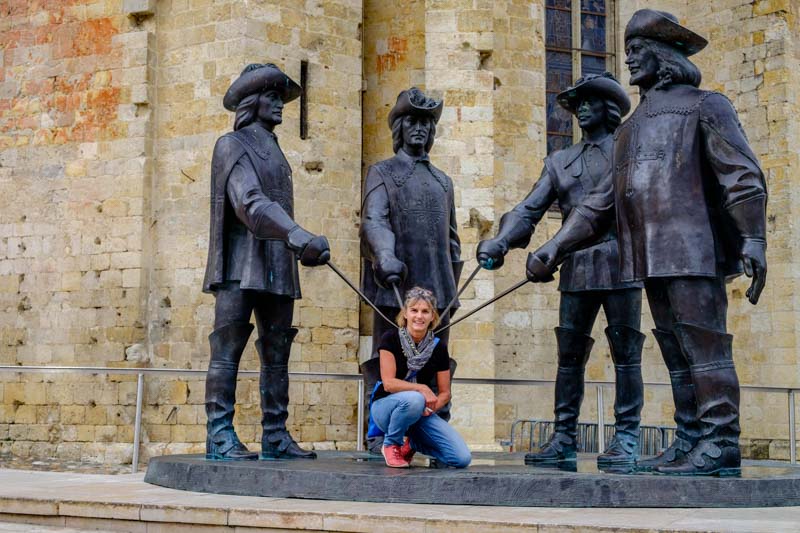
Condom wins the prize for best aire this week – spacious, hardstands, picnic tables, nice outlook, and free. A walk along the riverbank took us into the town which was a lot livelier than some towns we have been to. There was an imposing, ornate old church and bronze statues of D’Artagnan and the three musketeers. The tourist office said that D’Artagnan had been born nearby.

It was raining lightly that evening and too late to change the menu of the day, so Stuart stood outside in his rain jacket holding a rainbow coloured golf umbrella over the barbecue while he barbecued pork chops. This device is connected to gas and slides out from the side of the truck and can be used as a regular cooktop also. The rain deterred any male on-lookers. Generally when we use the barbecue we get men coming to have a look at a gadget they haven’t seen before. Some return with their wives in tow, pointing out the ‘must have’ accessory.


The town of Condom, D'Artagnan and three musketeers

Sunny Spain beckons but we still have the Pyrenees mountains to explore, so you will have to wait for the next exciting installment to hear all about it.